

Now more than ever—as material shortages, supply chain issues and talent gaps dominate the industrial world—manufacturers need to utilize the power of data to improve operations and reach their production goals. While data is key to making these improvements, it’s challenging to successfully move information from multiple sources to one specific place so it can be processed and analyzed.A solid data ingestion process helps you effectively connect a wide variety of data structures to where they need to be—making sure the data is harmonized, in the correct format and has the same level of quality.
Data Ingestion to Calculate OEE (overall equipment efficiency) is a popular KPI (key performance indicator) used in manufacturing environments.
It measures how well a plant runs.For example: An OEE score of 50% means your operations are running at half their theoretical optimal performance. An OEE score of 100% means you have perfect production: All manufactured parts are of good quality, they’re manufactured as quickly as possible and there is no downtime. For discrete manufacturers, the average OEE is 60%—and this number indicates room for substantial improvement.According to author Robert Hansen’s book, Overall Equipment Effectiveness, “A 10% improvement in OEE can result in a 50% improvement in ROA (return on assets), with OEE initiatives generally 10 times more cost effective than purchasing additional equipment.”
3 Variables You Need to Determine OEEThe challenge in determining OEE comes down to collecting the right data from disparate data sources—and that’s where data ingestion comes into play. It helps critical data from IT and OT data sources get to the right places.
- OT data sources come from the operational technology on the plant floor outside the realm of traditional IT. Examples of OT data sources can include PLCs (programmable logic controllers), BASs (building automation systems) and industrial sensors.
- IT data sources are typically on-premises or cloud applications that contain information related to operations. Examples of IT data sources can include an MES (manufacturing execution system), QMS (quality management system), ERP (enterprise resource planning) system and CMMS (computerized maintenance management system).
Data from OT and IT data sources are used to calculate the three factors that make up OEE. Let’s take a look at each one.1. Plant Availability

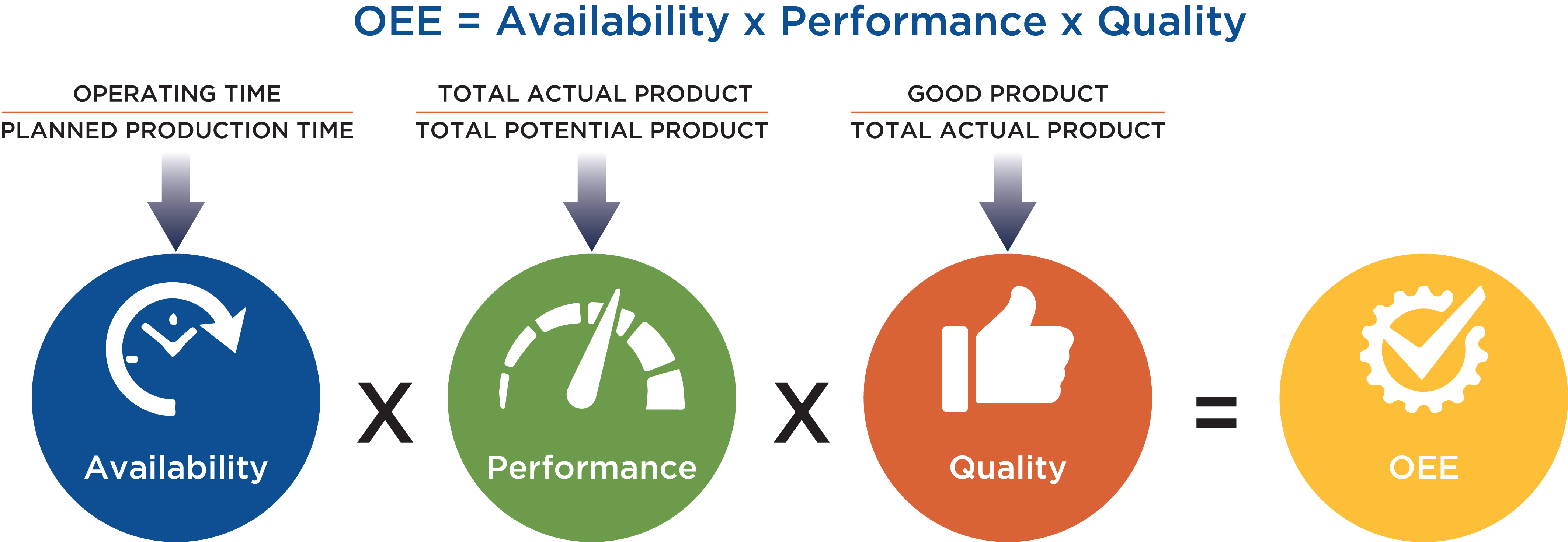
Is your plant up and running? That’s what “availability” refers to here. Availability represents production time—or how long a plant or piece of equipment can perform as intended. It takes availability loss into account (any event stopping planned production long enough that it’s worth tracking the reason for downtime).The data you need to calculate plant availability includes:

2. Plant Performance

Performance represents the ability of a manufacturing process to run at maximum possible speed. It takes performance loss into account, which includes any factor that causes production to operate slower than the maximum possible speed.The data you need to calculate plant performance includes:

3. Quality

Quality represents manufactured parts that meet quality standards. It’s similar to first pass yield (how many parts pass through the manufacturing process without requiring rework).
The data you need to calculate quality includes:

Once you have these three values—availability, performance and quality—you can determine your OEE using this formula:
3-Step Data Ingestion Process to Calculate OEE and Other KPIsWe all know the adage, “If you cannot measure it, you cannot improve it,” made famous by Lord Kelvin (a.k.a. William Thompson). Because data ingestion is necessary before you can measure, a modern revision of the quote could be: “If you cannot securely and reliably ingest data, you cannot measure it—and, if you cannot measure it, you cannot improve it.”Luckily, today’s data ingestion processes are much more cost effective and scalable than they were in Lord Kelvin’s day. Following this three-step process will help you successfully move information from multiple sources to one or many destinations so it can be processed and analyzed.
- Connect Your Data To connect your data, you need an infrastructure that supports the digitization of processes and connects various data sources to the network through components like cables (copper and fiber) and networking gear (switches, routers, edge gateways, etc.).
- Collect Your Data Once your data is connected, you need to be able to collect it. This process involves ingesting and transforming data from various protocols and manipulating payloads within the protocols so they can be collated with other data sources. This table represents examples of different protocols and payloads involved with IT and OT data.
- Collate Your Data
How Belden Helps with Data Ingestion
- Our team of experts can show you how Belden’s industrial edge solutions support data ingestion so you can calculate OEE and take steps to improve plant processes.
- Our industrial edge solutions help you carry out the three-step data ingestion process. Connect your data with a wide variety of cabling, networking equipment and protocol converters. Then, collect and collate your data with industrial edge gateways that support containerized protocol conversion, payload transformation and data collation applications.
- Later this year, Belden will launch a series of robust industrial edge gateways and orchestration capabilities to provide your industrial operations with secure, flexible and scalable edge compute functionality. Stay tuned to our blog to learn more.